


Lewis Kimani Waiyaki, who recently passed away was among the first Kenyans to study law.
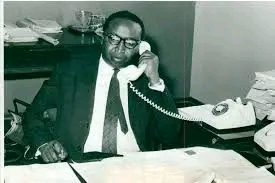
A descendant of chief Waiyaki wa Hinga, Waiyaki had studied in Uganda and Durban South Africa before proceeding to America where he arrived in 1951 when he was only 23.
To prepare for university education, he spent a semester at Hillyer College , Hartford, Connecticut after which he proceeded to University of Pennsylvania for his BA (Social Science) then to Roosevelt University Chicago for his MA (Political science) and eventually to Goshen College Indiana.
Having come from Kenya colony where the freedom and the rights of the Africans were restricted, Kimani found the American society quite open to divergent views and to a great extent, sympathetic to African causes.
He used the opportunity to highlight the plight of Africans by giving talks and appearing as a panelist in nationalistic discourses.He was a panelist when Professor Ahmed Shah Bokhari , head of the Pakistan Permanent Delegation at The United Nations gave a talk titled “Nationalism in Asia and Africa” during the 7th annual International Students Conference held at Bard College on April 18, 1953.
When the Bible was first translated to Olulogooli,a Luhya dialect spoken by the Maragoli of Western Kenya , the first copy was presented to Kimani by the world famous Bible translator Dr Eugene Nida during the American Bible Society 135th annual meeting in New York in 1951. By then he was a student at the University of Pennsylvania.
Driven by the desire to fight injustices back home as the wind of Black nationalism swept across the African continent, Waiyaki moved to London to study Law and to sit for his bar exams. In those years London served as a hub for anti-colonial activism. It was where students and anti-colonial activists from British colonies connected with the British left and other like-minded individuals.
Among the young Kenyans who were politically active in London at that time were Kihara Mutu Ngumbu Njururi, Othigo Otieno, Burudi Nabwera, John Akumu among many others. Most of them were students, and Waiyaki was part of them. During the Second Lancaster in 1962, Waiyaki was among the students who met a delegation lead by Jomo Kenyatta, Oginga Odinga and Tom Mboya.
But there is another story to this constitutional making process. During the conference both Kenyatta and Odinga stayed at Cumberland Hotel. Kenyatta having just come from prison was still financially dependent on Odinga who was receiving huge sums of money from the Russians and Chinese who had made him their point man in East Africa.
During a previous visit to London Kenyatta, had visited the Ml5 headquarters,where he spent some time being advised by the British intelligence agency’s director on the danger of communism and associating with China and Russia.
Therefore even though Kenyatta was desperate for money he feared associating with the Chinese and the Soviet out of fear of antagonising the British and jeopardising his chances of ever leading Kenya. He therefore left it upon Odinga to continue dealing with the Chinese and the Soviet, but got his share of the money Odinga was given
They also needed to raise money not only to counter KADU but also to counter the Mboya faction within KANU. By then Mboya was a threat to the two. For this reason Odinga held a number of meetings with Chinese and Soviet diplomats to raise £500,000 to organise KANU. The first meeting with the Soviets was held in a private residence. But later on when the Soviet realized that the British had bugged the building, decided to move their next meeting to the Soviet Embassy in Kensington, hoping that it would be secure. But they were wrong. The British still managed to sneak through the Embassy and installed listening devices.
According to the information that was retrieved from the listening devices, in the course of the conversation the Soviet mentioned the difficulties they were having to differentiate the many requests for financial assistance they were receiving from Kenyans who were invoking the name of Kenyatta. They said a young man called Kimani Waiyaki had approached them with a letter signed by Kenyatta demanding £5000. The Soviet didn’t know whether Waiyaki was acting for himself or Kenyatta who had sent him secretly behind Odinga’s back. According to the Soviet they only knew Odinga as their only channel for scholarships and money meant for East Africa .
To cut the long story short, that same year with independence in sight after the 2nd Lancaster Conference, Kimani Waiyaki made his way back to Kenya armed with a Law degree from London, and a BA and an MA from America. He got a job as an Assistant Legal Secretary in the East African Common Service Organization (EACSO)in October 1962. EACSO was later supercedes by East African Community.
On May 1, 1964 Just after independence,he was hired as the first African Town Clerk for Nairobi, but on probationary terms pending his confirmation. But in just three months , the relations between him and the Council led by Mayor Charles were already strained. On January 1, 1965, the Nairobi City Council convened and unanimously voted against his confirmation as Town Clerk and terminated his appointment on claims that he lacked administrative experience.
The truth is that Waiyaki was a victim of the battle within KANU where those allied to Odinga were purged from public service by the Gatundu Group. The decision to fire Waiyaki as Town Clerk ignited a heated debate in parliament with Ngala Abok the member of parliament for Homa Bay accusing Mayor Charles Rubia of undermining Kimani Waiyaki. Arthur Ochwada the MP for Funyula asked Lawrence Sagini, the Minister for Local Government, what administrative experience Waiyaki needed yet he was well learned.
”He has good degrees, a BA and a degree in law, but the snag then was administrative experience,” the minister replied while siding with the decision of the Nairobi City Council.
The following year Odinga resigned from the government and among those who left with him to form KPU was Kimani Waiyaki who became the administrative secretary of the new party. As the Kenyatta government launched an assault on Odinga and his allies who had left KANU, among those targeted was Waiyaki, who also operated successful businesses in Kampala Uganda. They included a bar and a restaurant.
Kimani Waiyaki was accused of using his businesses and contacts in Uganda to fund Odinga’s activities. As result, in March 1968 the Kenyan Special Branch working with their Ugandan counterparts, abducted Waiyaki in Kampala and drove him to Kenya where he was tortured and detained in inhumane conditions without trial for eight months.
He later blamed Charles Njonjo for his troubles saying ,“From the time I joined KPU Mr Njonjo threatened to finish me for being a traitor.”
His association with Odinga was viewed as a betrayal to the Kikuyu. In 2015 , he moved to court to seek compensation for wrongful detention by the Kenyatta Government and the loss of his vehicle and businesses which were looted and vandalized in Kampala after he was abducted.
