


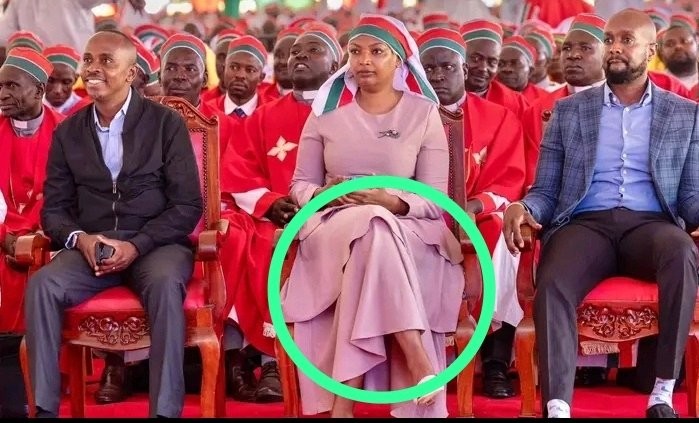
Kenyan priest Father Kinyua sparked a heated conversation online following his comments on the sitting posture of two prominent female politicians who attended a church service with President William Ruto.
The service took place at the Africa Divine Church (ADC) in Nairobi, where notable leaders such as Senator Karen Nyamu and Nairobi Women Representative Esther Passaris joined President Ruto in worship.
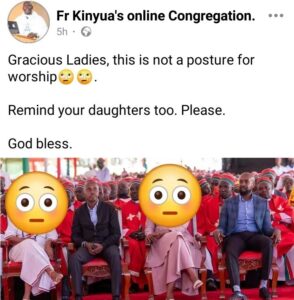
However, what gained widespread attention was not the leaders’ participation in the service but rather the way they sat during the ceremony.
Photos from the church event, widely shared on various social media platforms, showed Karen Nyamu and Esther Passaris sitting with one leg crossed over the other.
This posture, according to Father Kinyua, was inappropriate for a worship setting.
Taking to his Facebook page, the priest addressed his concerns, writing, “Gracious ladies, this is not a posture for worship.”
His remarks quickly attracted responses from Kenyans, with some defending the politicians’ freedom to choose their sitting posture, while others sided with Father Kinyua’s traditional perspective on church decorum.
Father Kinyua’s opinion stems from a belief in maintaining a sense of modesty and reverence in church, especially for female attendees.
In many traditional African and religious contexts, it is believed that women should sit with both feet on the floor as a sign of respect, humility, and grace.
According to some religious viewpoints, crossing one leg over the other could be seen as a more casual or even bold posture, which some consider inappropriate for a church environment.
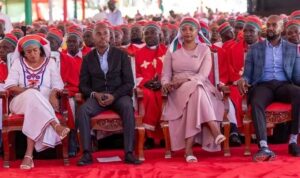
Father Kinyua’s comment underscores this perspective, as he urged women to adopt what he considers more suitable postures during worship services.
The priest’s comment has prompted a variety of responses from Kenyans, with some interpreting his view as a reminder of conservative values in worship spaces.
Others, however, see it as an unnecessary policing of women’s behavior, arguing that worship is about the sincerity of one’s heart rather than the specifics of one’s posture.
The backlash and support from both sides highlight an ongoing discussion about the role of tradition, decorum, and personal freedom in religious settings.
Senator Nyamu and Women Representative Passaris have not publicly responded to the criticism.
Both women are well-known figures in Kenyan politics and are often celebrated for their outspoken nature and dedication to their roles.
However, this incident has once again brought them into the spotlight, with Kenyans debating the intersection of faith, gender, and cultural expectations.
In the age of social media, such interactions between church leaders and public figures can quickly go viral, amplifying debates on societal norms.
Father Kinyua’s post has reignited a familiar dialogue in Kenya regarding the expectations placed upon women, particularly those in public roles, when attending religious gatherings.
The topic also raises broader questions about the changing landscape of religious and cultural norms in Kenya, where traditional expectations are often balanced against modern ideals of equality and individual expression.
As women increasingly occupy influential roles in politics and public life, they bring a new perspective to long-held cultural practices, sometimes challenging norms that previous generations adhered to without question.
Father Kinyua’s reaction to the sitting posture of Nyamu and Passaris at the ADC church service serves as a reminder of the complex dynamics between tradition, religion, and modern-day freedom.
While some may argue that church decorum is essential to maintaining a respectful worship space, others believe that personal choice should be respected, even in religious settings.
As discussions around this topic continue, it’s clear that the relationship between public figures and traditional expectations remains a subject of keen interest and spirited debate in Kenya.
