


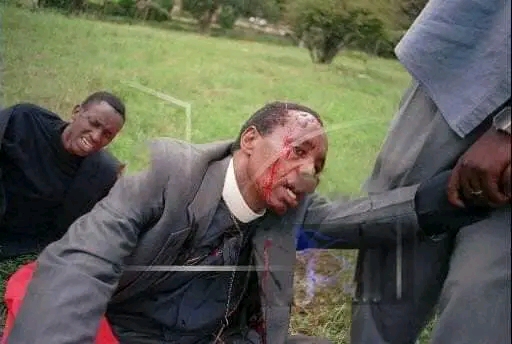
KANU youth wingers almost killed Reverend Timothy Njoya, a leading critic of the Moi government, outside parliament in 1999.
The protestors led by Njonjo marched outside parliament,with their mouths gagged and their hands tied behind as a sign of oppression of the entire nation by a tiny clique of politicians.
The previous day, church leaders had held a press conference calling upon Moi to reconsider his decision of entrusting parliamentarians with the constitution making process. They insisted that citizens had to be involved in the process.
“We will do anything within our powers to ensure that the review process is driven by the people as a right and not parliament,” said Catholic Archbishop, Ndingi Mwana a’ Nzeki. Moi on his part had argued that placing the responsibility of changing laws on Wananchi who knew very little about the constitution would be a burden.
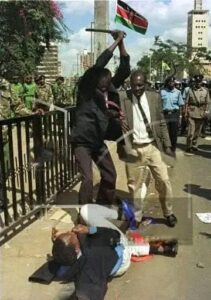
While insisting that parliament should undertake the process, Moi asked: “Why should they (members of parliament) relinquish their responsibilities to other people?” It was against this backdrop that Njoya led protests outside parliament resulting in his assault.
Patrick Shikanda Lokhotio the youth winger photographed hitting Njoya with a club, would later visit Njoya’s Church at Kinoo, confessed his sins and became a born again Christian.
Njoya had been a fiery preacher and a critic of the government from the 80s. On October 5, 1986 he gave a fiery sermon at St Andrews Church Nairobi decrying the prevailing political, economic and social situation in the country . But what annoyed politicians most was a call by Njoya that all Kenyans who had grievances, including fugitives, dissidents and malcontents should be accorded a forum by the government so that they could speak their minds.
Within the PCEA itself there were senior church officials who also felt that Njoya had gone too far. Among them were the PCEA moderator, the Rev. Dr. George Wanjau, and the secretary-general Rev. Dr. Plawson Kuria. They applied to the Ngong Hills presbytery court to have Njoya disciplined because of his sermon. However, the presbytery court in its verdict found nothing wrong with the sermon and refused to take action against Njoya.
The business committee of the church was not satisfied with the ruling and decided to appeal, but before the appeal could even be heard, the PCEA leadership made a decision to transfer Njoya from Nairobi to Nyeri. Njoya saw this as punishment and said that he would rather resign than go to Nyeri.
Describing the transfer as “a heretical and idolatrous disciplinary action”, Njoya said it amounted to a repatriation to his home area and that he would rather “go home in triumph, not in disgrace.” He went on to submit his retirement letter to the Ngong Hills presbytery.
Referring to the controversial sermon in the letter he stated. “In view of my conviction that the holy spirit led me to preach those sermons and the same spirit may lead me to utter similar sermons elsewhere, I hereby request the presbytery of Ngong Hills to grant me retirement on the grounds of my conscience effective March 31″.He went on to say that he “cannot compromise with the cowardice of those who wish to appease the world”. “I brought nothing. to this world, I shall return to God with. nothing,” he wrote.
Clergy from the mainstream churches, especially Catholic and Anglican, were very vocal during Moi’s regime. They went silent when Kibaki took over and remained so during Uhuru’s regime. They are now finding their voices again by calling out Ruto’s government. Traditional African churches on the other hand have always been hesitant to criticise the government while most pentecostal churches have always adopted a wait-and-see attitude before joining the criticism.
