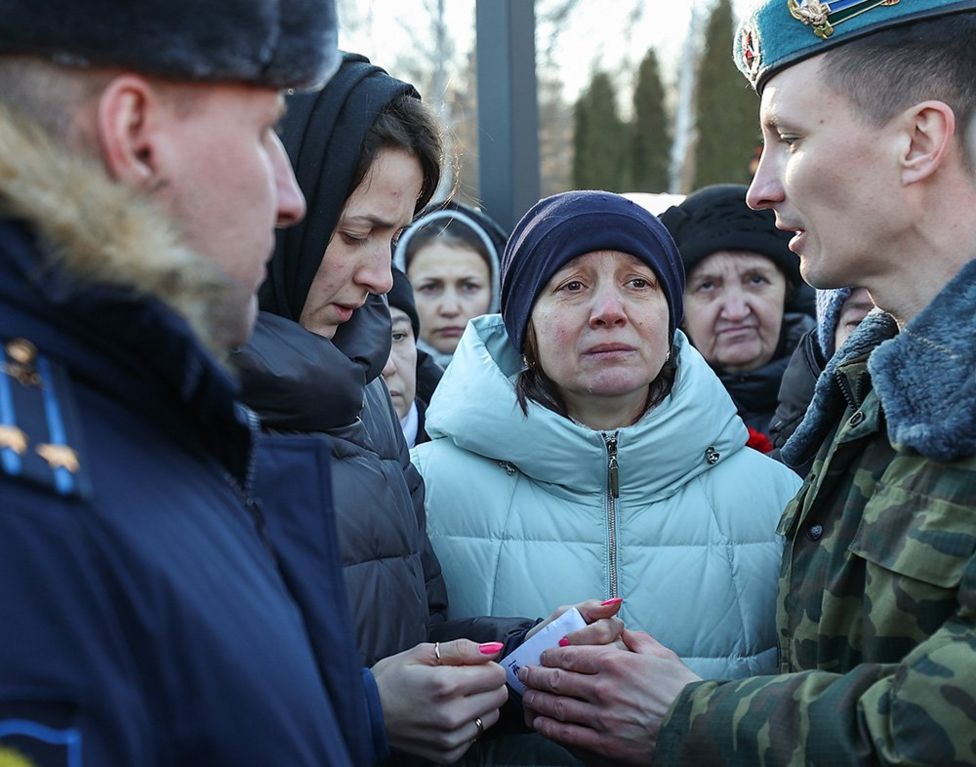


Ukraine: Mother of Russian soldier asks ‘Whose door should I knock on to get my child back?
President Putin has directly addressed the mothers of soldiers serving in Ukraine, telling them: “I know how worried you are” and trying to reassure them. But some mothers, grandmothers, sisters and girlfriends have been telling the BBC they are desperately anxious about loved ones in the military – young men who appear to have had little idea what they were being sent to do.
All names have been changed
When Marina hadn’t heard from her grandson for more than a week, she started making calls. In his final message to her, he said he was on the Belarus-Ukraine border and would be home soon. But with no news since, she fears the worst.
“I phoned his military unit, they said he hadn’t left [Russia]. ‘I said – are you joking? He contacted me from Belarus. Do you not know where your soldiers go?’ They hung up and didn’t talk to me any more.”
Marina’s grandson Nikita was originally a conscript. Men in Russia aged 18-27 who do not have an exemption – such as studying or looking after young children – are drafted into the military for a year.
But Marina says in Nikita’s first few days of service, representatives of military units arrived in their region, hoping to get conscripts to become contracted soldiers in order to lengthen their military service and earn a salary. Contractors make up the bulk of Russia’s junior service personnel.
They “convinced him”… “[They told him] you can retire early, you will have a steady salary, you will learn how to drive.”
Nikita became a driver in a mechanised infantry division, but his earnings did not translate into a comfortable standard of living. His monthly salary of 18,000 roubles – $240 (£180) before the rouble crashed – was just enough to get by on in rural Russia. And, he told his grandmother, he was expected to pay for uniform and petrol out of that salary. He had free accommodation in barracks but could not bear the freezing conditions – there was no heating or hot water – so had to pay for rent as well, she says.
 The funeral in Moscow last week for a Russian sergeant killed in Ukraine
It is difficult to establish how common Nikita’s experience is, but the scores of Russian companies who help young men find loopholes to avoid the draft suggest the army is not seen as an attractive prospect.
In mid-February, Nikita told his grandmother he was moving to the Ukraine-Belarus border “to guard it”. He also told her he had heard they would soon be returning home.
There has been no word from him since he last texted her on 23 February – a Russian public holiday – to say he was at a concert.
She is certain her grandson had no idea he would be sent into combat in Ukraine.
“He said, ‘It’s drills and more drills and then we go home’,” a line repeated by many Russian soldiers’ relatives we spoke to.
Another woman, Galina, says she only realised her son Nikolai was in Ukraine when her sister spotted his photo on the Facebook page of Ukraine’s armed forces’ chief as a POW.
A US Pentagon briefing on Friday suggested that a significant number of the men fighting in Ukraine are conscripts, and that might account for their inexperience and lack of awareness about what they were expected to do.
But it appears the men’s belief – that they were simply on drills rather than being sent into combat – was not unique to conscripts. Like Marina’s grandson Nikita – and many of the other men whose relatives we spoke to – Galina’s son Nikolai began as a conscript, but was now a contracted soldier.
Galina says she last heard from Nikolai the day before her sister spotted his photo, when he told her his unit was near the Ukrainian border.
“I don’t know what to do. The media is silent about the fact that our guys were captured. Or they don’t know.”
Nikolai’s girlfriend says he became a contract soldier last December to “provide for his future family”, despite her efforts to dissuade him. His mother adds that there are no other opportunities to earn decent money locally.
“My child did not go [to Ukraine] of his own free will, the commander-in-chief sent him there,” she says.
“To be honest, I don’t understand what it’s all for,” she says. “In our country, some people have nothing to eat. I don’t understand any war or any military action.
“Whose door should I knock on to get my child back?”
This sense of impotence is shared by another mother the BBC spoke to, whose son also worked as a contract soldier and was sent away on “drills”.
“If I knew where he is now, I would have packed up myself and gone to these people and begged them for mercy,” she says.
Historically, soldiers’ mothers in Russia have been outspoken about how the military has been deployed and treated, and have agitated for the authorities to be more open about casualty figures.