

Speaking before his death in 2015 aged 49 after suffering from stomach cancer, Moshoeu recalled how he broke down in tears when a white fan asked for his autograph.
South Africa still faced significant challenges; sport cannot solve everything. But Mandela recognised its power.
“Sport has the power to change the world,” he said. “It has the power to inspire. It has the power to unite people in a way that little else does.
“Sport can create hope where once there was only despair. It is more powerful than government in breaking down racial barriers.”
Radebe noticed a shift in dynamics immediately.
“Hearing white people say ‘you’re my hero, you’re my idol’ brought so much emotion because I remember what we went through all those years. That was the new South Africa,” he says.
“Our minds brightened up. Our eyes were seeing something beyond what we saw before. It was absolutely captivating. Just because of football.”
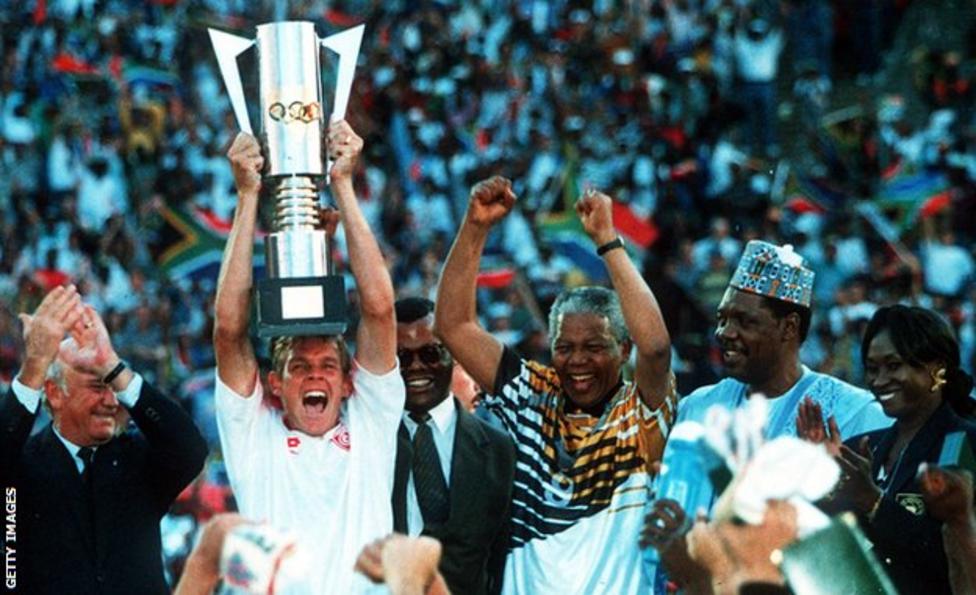
Tovey says that feeling lasted beyond the immediate days of celebration.
“Now there were more whites coming to the ground and watching big club matches and internationals. The support grew and grew through all the cosmopolitan groups.
“It was huge, what we did for the country. About 10 or 12% of the population was interested in the rugby but soccer, it was 90-95 percent. The white farmers even knew about Bafana Bafana now.
“That’s not degrading what the rugby players did for the country. They were the first to do it in 1995, and they did a hell of a wonderful job.”