


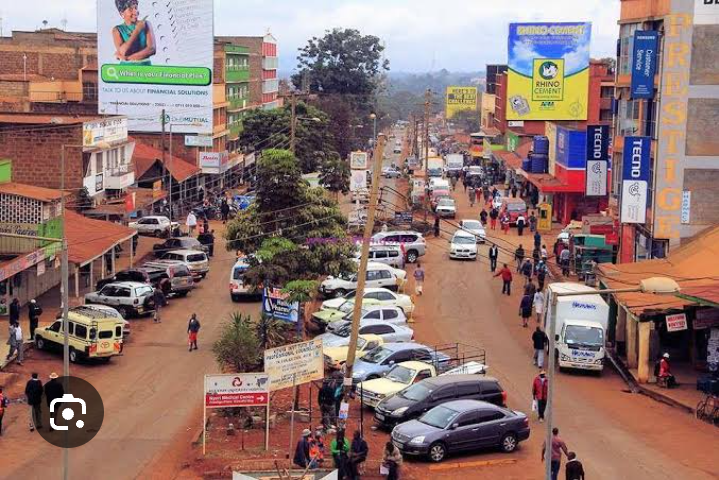
Nyeri Town.
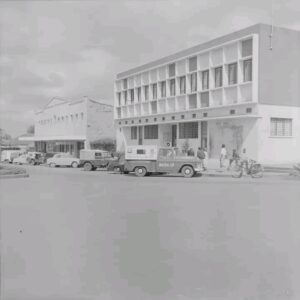
According to evidence presented before the Kenya Land Commission around 1915, the European officer at Fort Hall Summoned Chief Wangombe to inform him that the government wanted to establish a station in his area. This was after the government officer heard how influential Wangombe was.
Even though Wangombe welcomed the idea, he requested the officer to allow him to return to his people so that he could consult them and also select a suitable place for the station.
After 10 days, Wangombe selected 30 men and returned with them to Fort Hall to report back . He told the European administrator that he had found a nice place at Thathwa near the Amboni River.
The European administrator was elated and assured Wangombe that he would personally visit the area to survey whether it was good for a government station.
Unfortunately Wangombe fell sick before the government party arrived to survey . He was briefly hospitalised at the Government hospital and discharged after showing some improvement. However after a week, his condition got worse.
Knowing that he was on the verge of death, he summoned the entire village, and informed them that he had made a deal with the government about the establishment of a government station at Thathwa.
He told the villagers that the reason why he had chosen Thathwa which wasn’t far from Laikipia, was because it was near the border of the Kikuyu and the Maasai, therefore, the station could be used to prevent regular raids between the two communities.
While on his death bed Wangombe also summoned his son Nderi, and told him that if he died he should show government officials the place he had selected for the construction of the government station.
His other wishes were that he should take care of his village and that he should create space for the construction of the government station by transferring his village to his own land at Kamaha located between Mweiga and Muringato rivers.
Chief Wangombe then died and his son Nderi buried him.
Four months after the burial, Government Officers led by H. Tate and accompanied by Chief Karori arrived at a market called Kachatha and sent for Nderi. When he arrived, the party asked him whether he knew the place his father had selected for the construction of the government station. He said “yes” and offered to take them to Thathwa (the place selected by his father).
The journey took them through Nyeri where the government delegation observed that it was the best place for a government station. Consequently the journey to Thathwa was halted and a unanimous decision was made that Nyeri should become the centre for the new government station.
Even though Thathwa was no longer needed for the establishment of the government station, Nderi decided to fulfil his father’s desire of transferring his village to his own land at Kamaha. He moved there with all his family members, relatives and livestock.
But during the delimitation of the new Nyeri Township, it was discovered that the late Chief Wangombe’s new village at Kamaha was within the boundaries. Nderi was consequently told by the European administrator in charge of the new station at Nyeri to move somewhere else.
Nderi argued with the administrator that he had nowhere else to settle his family and to keep or graze his livestock. The administrator assured him that his cattle would be allowed to graze in the Township and that if he found anyone who could shelter him and his family, the government would pay the person rent or compensation.
With this assurance, Nderi approached Ngatia wa Mahenia who gave him a piece of land to settle on. But the government never kept its part of the bargain. It never paid Ngatia for hosting Nderi and his family. And furthermore, Nderi’s livestock were prohibited from grazing in the Township after only two years.
He was then ordered to go back to their old village at Thathwa. Since the government had also taken over the land he was charged for grazing the livestock since the land had also been taken over
“When I got there I was charged to pay Rs. 6 (Sh. 12). Is it not a marvellous thing for a man to buy grass from the land which once was his?” Nderi complained .
Three years later he was again forced out of Thathwa.
“After three years I was again removed from Thathwa; I was told to go to live with Ndiuini in his own land. A number of my flocks died. I removed my flocks from Ndiuini’s; I took them to a white man’s farm, where I am still buying grass for my flocks up to date,” Nderi informed the land commission.
He appeared before the land commission to demand the return of his father’s land which had been incorporated into the Nyeri Township by the government.
“I beg now to claim for my father’s land, Kamaha, because the land question is now under consideration, and I was evicted by the local Government. I am now pressing for return of my land. I beg to lay my grievance before you, trusting that my petition will sympathetically be considered by the Government,” Nderi submitted to the commission.
