


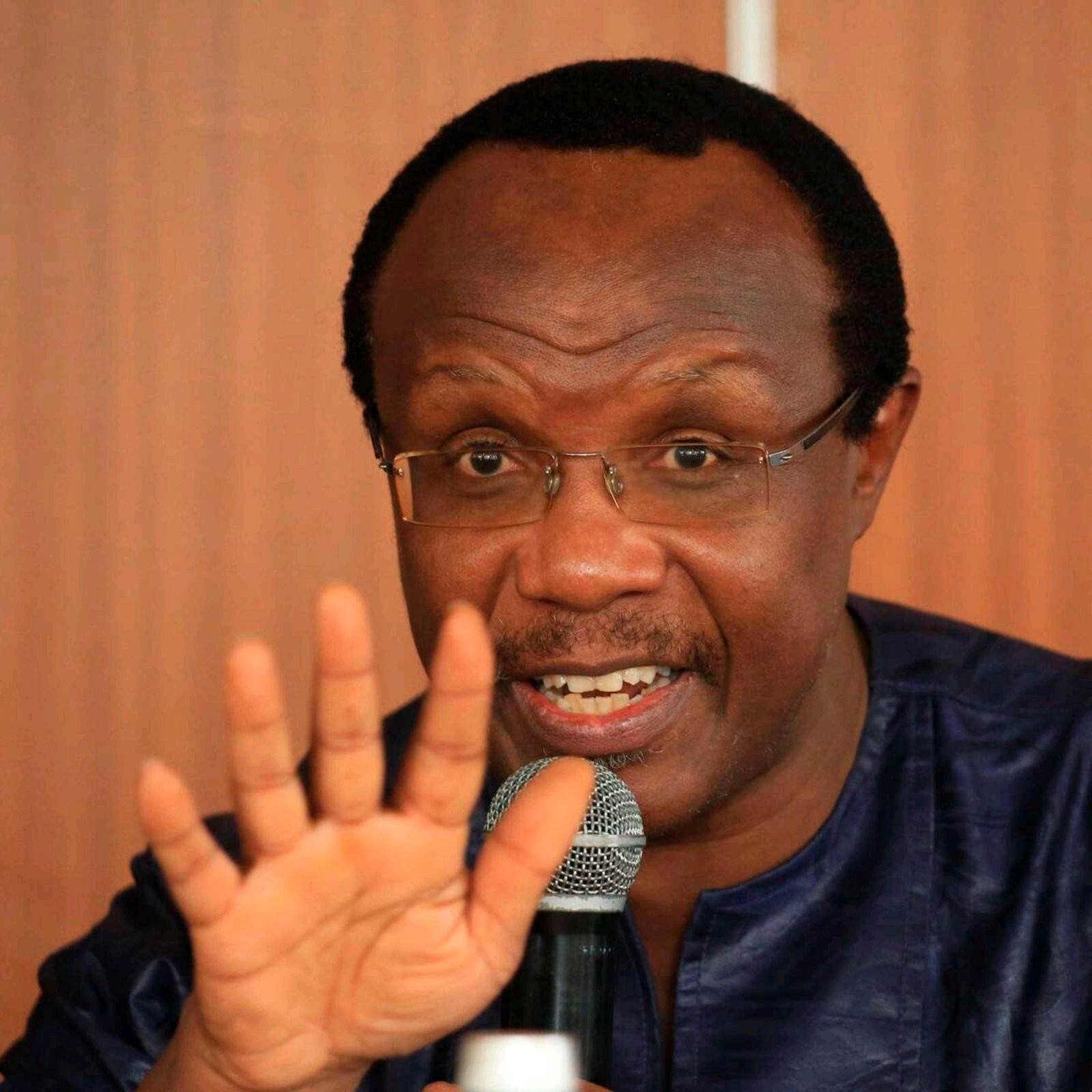
President William Ruto’s economic advisor, David Ndii, took to Twitter to confront Kenyans blaming him for the current economic situation in the country.
Dismissing the accusations, Ndii asserted that the government is actively implementing a solution—describing it as a painful but necessary process involving structural adjustment, an IMF program, and austerity measures.
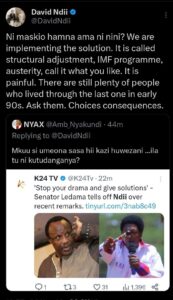
“Ni maskio hamna ama ni nini? We are implementing the solution. It is called structural adjustment, IMF program, austerity, call it what you like. It is painful.
There are still plenty of people who lived through the last one in the early ’90s. Ask them. Choices consequences,” Ndii responded via his official Twitter handle.
Ndii’s statement was prompted by criticisms regarding his alleged failure to address crucial issues affecting ordinary Kenyans and the country as a whole.
Undeterred, he maintained that the government’s approach, though painful, is aimed at long-term benefits.
The economic advisor emphasized that the ongoing measures, reminiscent of those in the early ’90s, are part of a strategy that, despite its challenges, may yield positive results in the days to come.
In response to Ndii’s defense, Kenyans took to Twitter to express their opinions on the matter.
Omondi delved into the technical aspects, highlighting that structural adjustment programs typically require borrowing countries to adopt free-market systems alongside fiscal restraint or outright austerity.
Sehn, however, expressed deep skepticism, accusing the administration of taking regressive measures without sufficient concern for the hardships faced by Kenyans.
He warned that mistakes made during this period would be remembered and the administration held accountable for its actions.
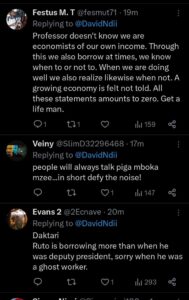
Festus, apparently unswayed by Ndii’s economic arguments, dismissed the professor’s statements, asserting that individuals are the economists of their own income.
He emphasized the importance of tangible economic growth felt by the people rather than being told about it.
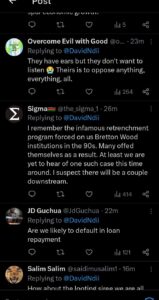
Sigma, reflecting on historical events, recalled the retrenchment programs of the ’90s imposed by Bretton Wood institutions, expressing relief that such extreme consequences had not been reported this time.
However, he speculated that downstream effects might still occur.
As Ndii faces a barrage of criticism and skepticism, the debate surrounding the government’s economic measures intensifies.
Kenyans are closely watching, demanding transparency and accountability during these challenging times.
