


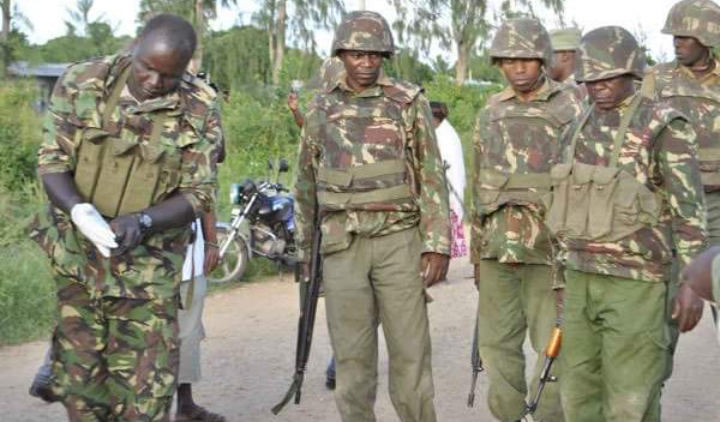
On Friday, February 17, the North Rift security operation began in earnest against robbers in six counties. The amnesty period, during which anyone in possession of illicit firearms was expected to turn them over to the authorities, ended without any such surrenders having been made. Vehicles belonging to the military were seen making their way through the dangerous areas.
The sites, according to the authorities, have been zoned so that careful and efficient operations can take place. The government has claimed that the military is ” simply” assisting the police in the operation.

Residents of Marigat town, the entry point to Tiaty constituency, reportedly stopped all activity as they watched the Kenya Defense Forces (KDF) roll in, according to eyewitnesses.
The increased presence of uniformed personnel on the ground indicates the beginning of a coordinated effort by the National Police Service (NPS) and the Kenya Defense Force (KDF).
According to plans, the operation will take law enforcement to the region’s hills, which have been suspected as bandit strongholds.
It will be difficult to cover all of the ground. This is due to a number of factors, including a general lack of materials and staff. In order to deploy, the military personnel headed to the designated sites.
In preparation for the launch of the operation, the several agencies involved in the exercise have been gathering and organizing their resources. Vehicles, helicopters, troops, shelter, and provisions were all on hand.
The new operation will be supervised by KDF Western Command Commander Maj. Gen. David Tarus, in conjunction with Rift Valley Regional Command Maj. Gen. Tom Odero.
Last month, a study outlining the issues and potential solutions was presented to the President under the title Technical Report on National Shared Security Strategy for Lasting Peace and Security in the North Rift Area.
After a local chief, two civilians, and eight police officers were murdered in Turkana East in September of last year, ” Operation Komesha Uhalifu North Rift” was launched. The document will guide the next phase of the operation.
In the wake of the military’s intervention, opinions were divided. The move was met with approval and criticism. The proposal to send KDF to the area was presented to Parliament on Tuesday.
If the drought worsens, the operation will likely focus on eliminating safe havens that bandits use, such as caves, and increasing ground and air support.
The security situation in the North Rift has been declared a National Emergency by Interior CS Kithure Kindiki, who has also granted a three-day amnesty for the surrender of unlawfully owned firearms.
Five guns were handed over. The lack of guns turned in has been blamed on poor communication, according to officials.
Some others think the amnesty that started on Tuesday won’t accomplish much because it gives the people responsible for the assaults time to recover and strategize.
The list of risky and unstable regions now includes even more locations. Specifically, the counties of Samburu and Laikipia saw the expansion.
The curfew will be in effect in the Sipili Division of Laikipia County and the Malaso, Baragoi, and Wamba Divisions of Samburu County, all of which have recently been added to the list of disturbed and dangerous places.
Nevertheless, Samburu County’s Kirisia Division was not included.
Japhet Koome, the Inspector General, issued a plea for all illegal gun owners in the region to turn in their weapons.
