


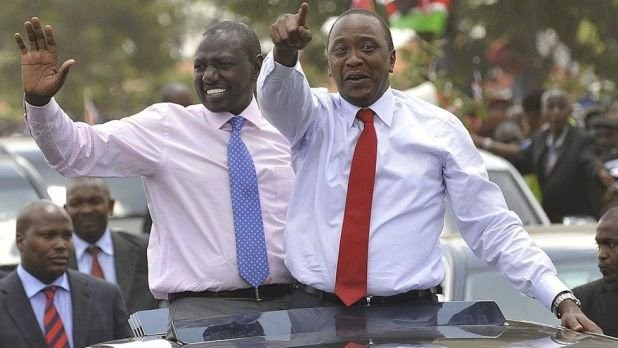
Wafula Chebukati, the commission’s chairman, named Mr. Ruto the victor with 50.5% of the vote and claimed the election was free and fair.
Mr. Ruto’s campaign rallies drew huge crowds. | Photo by Getty Images
Mr. Ruto entered politics in 1992; he claims that President Daniel Arap Moi was his mentor.
Mr. Ruto was an activist in the youth wing of Mr. Moi’s once-dominant Kanu party, and he helped organize voters in the country’s first multi-party elections the same year.
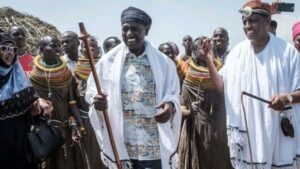
He is widely believed to be an effective public speaker, having attracted large crowds to his rallies and giving confident performances in interviews with the media.
His use of “My friend” as a conversation starter has helped him win over voters and silence his detractors.
After serving as minister of education and agriculture among others, he was elected vice president in 2013.
Mr. Ruto surprised many Kenyans by standing for office as the vice presidential nominee of outgoing President Uhuru Kenyatta, despite the fact that he and Kenyatta had been on opposing political sides in the preceding election.
Given that both had been accused of crimes against humanity by the International Criminal Court (ICC) for their roles in inciting violence during the very contentious election of 2007 in which almost 1,200 people lost their lives, the partnership was a practical one.
Mr. Ruto had supported Raila Odinga, the opposition candidate who lost to Mr. Kenyatta in the most recent election, while Mr. Kenyatta had supported the reelection of President Mwai Kibaki.
As a result of their collaboration, termed a bromance, the two men rose to power and were able to stave off the threat posed by the International Criminal Court (ICC) when the prosecution dropped charges against President Kenyatta in 2014 and judges dismissed the case against Mr. Ruto in 2016.
The two men were once an unstoppable force, but Mr. Kenyatta (R) and Mr. Ruto fell out.
Mr. Kenyatta’s 2018 about-face saw him reconcile with Mr. Odinga, crushing Mr. Ruto’s hopes that the outgoing president would endorse him as his successor in the current election campaign.
Ruto refuted accusations of insubordination from the president’s loyalists, but he did concede a breach between himself and the president, adding that they “view politics differently.”
Nevertheless, Mr. Ruto stayed in office thanks to constitutional procedures that guarantee the term of a vice president.
Mr. Kenyatta has extensively campaigned for Mr. Odinga in the current election, arguing that Mr. Ruto is “untrustworthy” and so unfit to hold the highest office in the land.
In response, Mr. Ruto claimed that Mr. Kenyatta wanted Mr. Odinga to succeed him because he wanted a “puppet president.”
He ran his entire campaign as a “hustler,” portraying himself as an outsider battling against the attempts of the Kenyatta and Odinga dynasties to maintain power in Kenya.
Powerful landowner and expert farmer
Mr. Ruto hails from the Kalenjin, Kenya’s third largest ethnic group, and the only other president to come from the tribe was the late Mr. Moi, the country’s longest-ruling leader. There can be no doubt that he is now the undisputed political leader of the neighborhood.
Mr. Ruto met his wife, Rachael, at a church youth group and they later married.
They’ve spawned a brood of six so far. Their daughter, June, is employed by the foreign affairs ministry, and their eldest son, Nick, has been the subject of rumors that he is being groomed for a political post after receiving a blessing from Kalenjin elders.
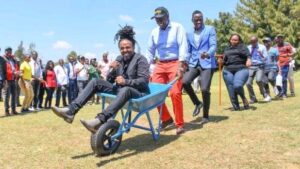
Mr. Ruto has promoted his image as a “hustler” by distributing wheelbarrows to local children.
Mr. Ruto is quite interested in farming, and as a result, he has tried his hand at raising maize, dairy cows, and chickens.
He has substantial holdings in the hospitality sector as well as vast tracts of land in western and coastal Kenya.
Mr. Ruto’s wealth and involvement in government corruption scandals have sparked widespread rumors about his origins.
A farmer accused him of stealing his land in the 2007 post-election unrest, and in June 2013, the High Court ordered him to return the 100-acre (40-hectare) farm and pay the landowner compensation.
He has denied any wrongdoing and has appealed to people by promising to help them achieve the American Dream.
