


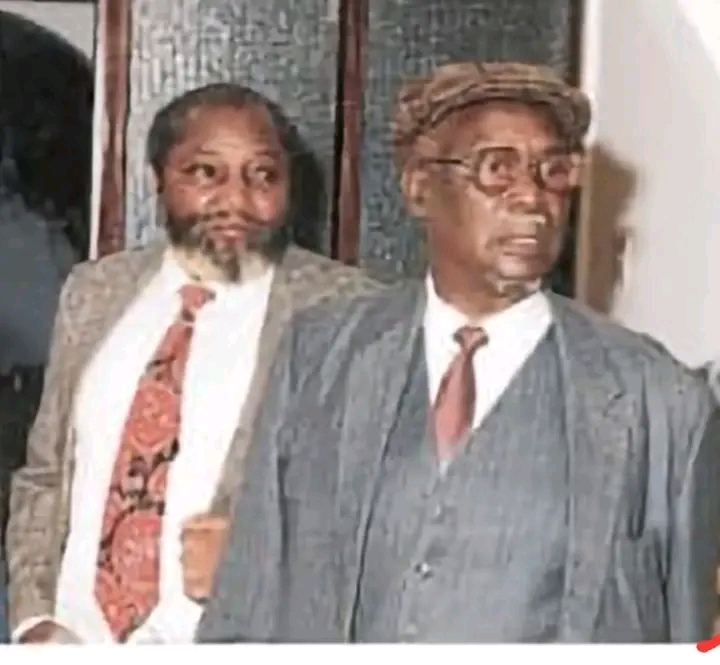
JORAM JAPHETH OYANGI MBAJA
J Mbaja was a radical nationalist and agitator who was imprisoned by the colonial government in 1957, the Kenyatta government in 1966 and 1971, and the Moi government in 1986.
Mbaja first came to the notice of the government as a radical agitator in 1950, when he opposed the Maragoli Hills Afforestation Scheme. Later he moved to Nairobi where he obtained employment, first on the staff of “Baraza” and then with “Jicho” newspapers. He also joined trade unionism.
Around that time he befriended Tom Mboya and became one of his key hachetmen alongside Denis Akumu.
In 1957, Oyangi played a prominent role in the formation of Tom Mboya’s Nairobi People’s Convention Party and as the secretary of the party’s ” Jim Crow Committee” he took part in the demonstration against Sir Roy Welensky. Together with Tom Mboya and Martin Shikuku they once entered Stanley Hotel which was preserved for white and ordered their food. They only left after the hotel’s management called the colonial police.
Mboya would later appoint him as propaganda secretary in the NPCP. In that role, he clearly demonstrated his advocacy of extreme actions including violence in dealing with colonialists.
Because of his militant approach to matters, the Governor made a detention order against him in March 1959, alongside other radical members such as Omolo Agar, Josef Mathenge, and Denis Akumu.
When the detention order was issued, Oyangi was in Ethiopia where Tom Mboya had sent him to run some errands for him, especially meeting senior Ethiopian government officials.
While in Ethiopia, he met Ethiopian Minister for Foreign Affairs on behalf of Mboya, addressed Kenyan students at the Imperial college of Engineering Addis Ababa and met Mau Mau refugees in Ethiopia led by Njoroge who asked him to seek Mboya’s support for their enlistment into the Ethiopian Army.
He also had a meeting with Okello and Anam, two Luo officers who worked in the Ethiopian military. Okello was a Lieutenant in the Ethiopian Army while Anam was a Major in the Royal Ethiopian Air Force.
On his final day Oyangi had an audience with Emperor Haile Selassie and delivered a special message from Mboya. Haile Selassie gave him some money and asked him to tell Mboya to provide 20 Kenya Africans who were to be enlisted in the Ethiopian Army, Air Force , Navy and educational institutions.
On March 27, 1959 immediately Oyangi landed at Nairobi Airport aboard an Ethiopian airline plane; he was arrested by the colonial police. Mboya was present at the time and tried to speak to him privately. When permission was refused Mboya became very perturbed and enquired if any documents had been found on Oyangi by the Police.
Oyangi was subsequently placed in Nairobi Prison from where he smuggled a letter to Mboya through his girlfriend Wamboi who had visited him. In the letter he described his activities in Ethiopia.
Part of it read:
“Dear Brother Tom Mboya,
In the last note I gave to WAMBOI when she visited me on Monday, March 30th, to bring to you, I briefly stated that the letter addressed to you by the Ambassador of Yugoslavia was taken by the police. As we had previously arranged before I left for Addis Ababa, I carried the letter in one of the newspapers I bought, hoping that I will meet you inside the Airport so that I handed over to you before entering the Customs Office. But I was very surprised to find that you were not there and when I tried to enquire the Police were already on me and directed me to a small empty room inside which they inspected all my luggage including my pockets and shoes.
“Lastly on March 23, I met His Imperial Majesty, The Emperor, HAILE SELASSIE I, for one hour. (Agreements reached with him are on a separate piece of paper).
“Socially Addis Ababa is far much better than New Delhi or Bombay of India.
“As mentioned in my earlier note, the Emperor granted me personally the sum £200 Sterling which is equal to 1400 Ethiopian dollars for my use. While in Addis I used Ethiopian dollars 248.78, the remainder was to be sent to me through the Consul General. Would you please inquire through him about it. Please keep the money for me. You may, however, occasionally give some of it to WAMBOI so that she maintains paying the rent for my house.
“There are 7 ex-Mau Mau chaps who escaped to Ethiopia in 1956 and have approached the Government for inclusion in their Army. ATO BEFEKADU asked me to ask you to give your opinion to the Foreign Minister immediately. One of these chaps met me.
Yours truly,
OYANGI
“P.S. Please send me some books on politics to read. I had some and they were taken.”
Oyangi was. released after one year, but in April 1960 ,Just one month after his release, while attending a conference on Afro Asians Affairs in Conakry Guinea ,he walked out in protest against the final resolution on colonialism in Africa, which he claimed had been watered down .
Five months later in October 1960 after the formation of KANU, he rebelled and organised a mass burning of KANU manifestos for propagating colonial ideologies. He also turned against his ally Mboya for being too pro-west and propagating their ideologies.
In 1966, Oyangi was briefly detained by the Kenyatta government for being close to Odinga who had fallen out with Kenyatta and being a member of his party KPU.
In 1971, Oyangi was arrested and imprisoned for 7 years for being part of the 1971 foiled coup that sought to overthrow Kenyatta. He was released in 1979.
But again in 1986 as President Moi launched a crackdown on those opposing his government, Oyangi was among those who were picked up by the Special Branch in the middle of the night. By then Odinga had given him a job as a manager at Spectre International.
He was detained without trial for three weeks before he was brought to court to answer to charges of knowing about the existence of Mwakenya but failing to report it. For this he was imprisoned for 30 months.
He came out of prison in poor health because of torture and had developed diabetes. He couldn’t even buy drugs for his diabetic condition because he couldn’t get a job.
Nevertheless despite his poor health, in the early 90s he joined Jaramogi Oginga Odinga, Kenneth Matiba and George Nthenge in the clamour for multiparty politics.
J.O. Mbaja died a poor man at Kenyatta National Hospital Nairobi. He was a revolutionary who wanted a more socialist country characterised by egalitarianism and better distribution of wealth.
