



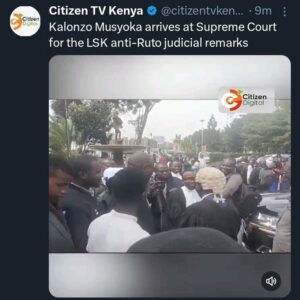
In a show of solidarity against President William Ruto’s recent criticisms of the judiciary, former Vice President Kalonzo Musyoka and Maina Njenga’s lawyer, Ndegwa Njiru, have arrived at the Supreme Court to participate in anti-government protests.
The opposition, led by Kalonzo Musyoka, is expected to join other lawyers in condemning what they perceive as an attempt by President Ruto to undermine the independence of the judiciary in Kenya.
The heightened tension surrounding the protest has prompted increased security measures within the Supreme Court premises and various parts of the Central Business District.

The Law Society of Kenya has taken the lead in organizing these demonstrations, expressing their concern over President Ruto’s recent statements targeting the judiciary.
Speaking to the press, former Vice President Kalonzo Musyoka emphasized the importance of standing united against any attempts to erode the authority of an independent institution.
He underscored the need to support lawyers, judges, and the majesty of the judiciary, stating that President Ruto should refrain from using his position to undermine the constitutionally mandated functions of the judiciary.
The protests stem from President Ruto’s recent criticisms of the judiciary, sparking widespread concerns about the potential implications for the rule of law and the separation of powers.

The Law Society of Kenya, as a prominent legal body, has taken a firm stance against any actions that could compromise the integrity and independence of the judiciary.
As Kalonzo Musyoka and Ndegwa Njiru join the demonstrators outside the Supreme Court, their presence adds political weight to the cause, turning the protests into a symbol of unity against perceived government overreach.
The opposition’s involvement underscores the broader implications of the issue, extending beyond legal circles and resonating within the political landscape of Kenya.
The demonstration is expected to draw attention not only from legal professionals but also from citizens concerned about the sanctity of democratic institutions.
The protest represents a significant moment in Kenya’s political and legal landscape, highlighting the ongoing tensions between the government and those advocating for the preservation of judicial independence.
As the protests unfold, the nation watches closely to see how these events will shape the discourse on the rule of law and the delicate balance between the executive and judicial branches of the Kenyan government.
