


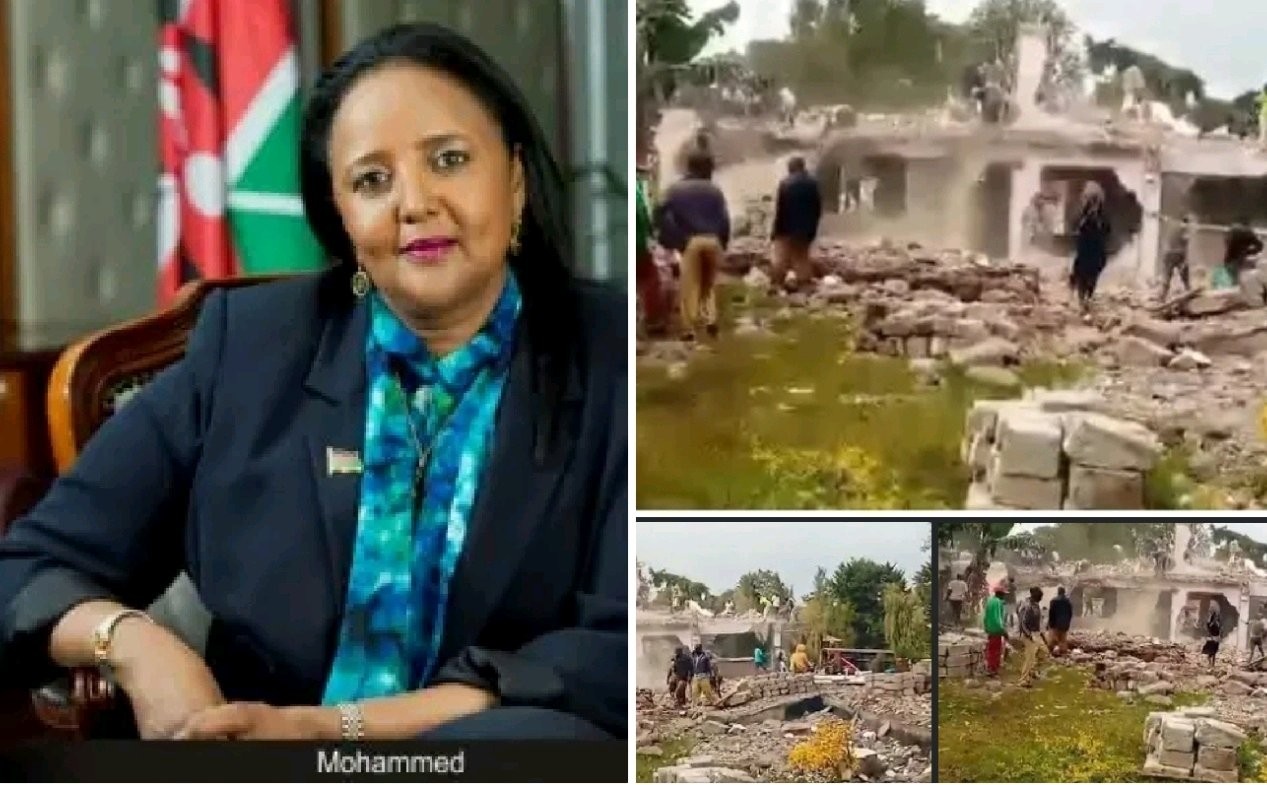
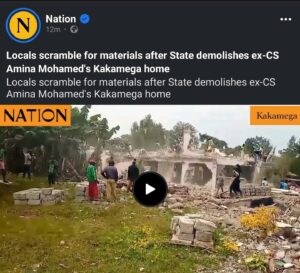
The government executed the demolition of former Foreign Affairs Cabinet Secretary Amina Mohammed’s residence in Kakamega County on Tuesday.
Situated in the upscale Milimani Estate, the house’s destruction was reportedly carried out to make way for the implementation of President William Ruto’s Affordable Housing project.
The residence, acquired by the diplomat’s brother in 2019, faced the wrecking ball as a contingent of demolition crew descended upon the scene.

The caretaker of the property recounted that the crew entered through the fence before initiating the demolition, a spectacle witnessed by the public.
Lucas Nandih Shamallah, the registered owner of the property, had previously secured an initial court order in October of the preceding year, calling for an immediate halt to the planned demolitions.
The Environment and Land Court in Kakamega had issued the order, temporarily preventing the government from razing the luxurious house, pending a hearing and determination of a suit filed by Shamallah.
Notwithstanding this legal intervention, the demolition proceeded, challenging the established legal boundaries.
The persistence of the government’s actions, despite a court-issued order, raises questions about the rule of law and adherence to due process in such matters.
It also underlines the complexities surrounding property rights and government-led development initiatives.
The controversy surrounding the demolition extends beyond Amina Mohammed’s property.
Notably, billionaire Jaswant Singh Rai, the chairman of the West Kenya Sugar Company, found himself among those affected by the widespread demolitions in the Milimani area.
This has sparked criticism from citizens who question the lack of prior warnings and the seemingly arbitrary nature of these demolitions.
In response to the public outcry and concerns raised, Kakamega Governor Fernandes Barasa felt compelled to clarify the county government’s position on the demolitions.
In a statement on November 30 of the previous year, Governor Barasa distanced his administration from the ongoing demolitions, asserting that they were not involved in the destruction of property in the Milimani area within Kakamega town.
The unfolding situation brings to light the intricacies of development projects and the conflicts that can arise between government initiatives and private property rights.
As the narrative continues to evolve, scrutiny of the legal processes and public accountability will be crucial in understanding the implications of such demolitions in Kakamega County.
