


Catholic priest Father Boniface Mbugua addressed the swirling controversy surrounding a clip where he was seen removing his priestly attire.
The clergyman took the opportunity to shed light on his actions, emphasizing his commitment to the ecumenical Catholic Church of Christ.
Father Mbugua, a figure previously known as “Si Dhambi,” revealed that he has a wife and children, showcasing his family in a TikTok video.
He asserted that his decision to marry aligns with biblical teachings, considering it the first rule from God.
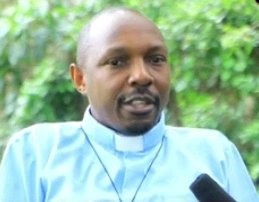
According to Mbugua, remaining unmarried contradicts divine directives, and the celibacy requirement for priests is, in part, a compromise to uphold the authority of the pope.
The priest delved into the reasons behind the prohibition of marriage for clergy, attributing it to economic considerations and the desire to control the wealth of the church.
Mbugua argued that priests, like any other humans, are entitled to engage in various activities, but the restriction on marriage serves a specific purpose within the organizational structure.
Addressing the viral video where he discarded his priestly garments and donned Kikuyu traditional clothing, Mbugua explained that his ethnic identity is not a matter of choice.
He emphasized that being a Christian does not negate his cultural roots, and he sees no conflict in embracing both aspects of his identity.
In his view, appreciating and enjoying secular art, including talents bestowed by God, is not incompatible with Christian values.
Father Mbugua adamantly stated that taking off his priestly attire and embracing Kikuyu traditional clothing should not be considered sinful.
He defended the notion that individuals have the right to be entertained and celebrate cultural diversity without compromising their faith.
The priest’s video, shared on various platforms, serves as an important clarification of his actions, challenging preconceived notions about the roles and personal lives of clergy.
As discussions continue to unfold, Father Boniface Mbugua’s public statements highlight the complex intersection of religious doctrine, cultural identity, and individual interpretation within the context of the Catholic Church.
