


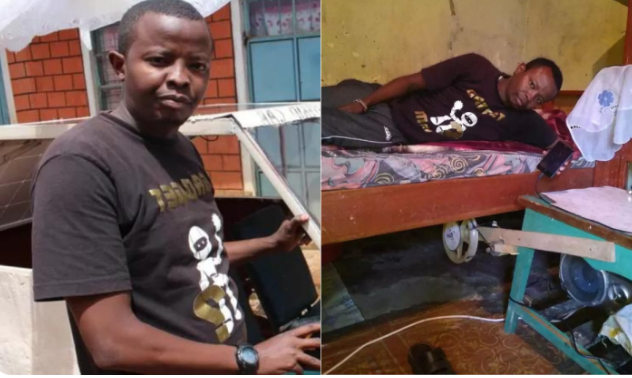
It was a Kenyan named Samuel Karumbo who came up with the idea of a bed that could be used to charge electronic devices.
Eldoret-based electrician Samuel Karumbo Ng’ang’a shot to prominence after creating a bed that could store energy and be used to charge mobile phones, tablets, and other electronic gadgets.
Karumbo said in an interview with NTV that physical contact between two people releases a great deal of energy that can be used later.
The article provides a detailed look at the electrician’s background, accomplishments, and advances in the workplace.
Origins and Formal Training
Karumbo was raised in the town of Langas, Uasin Gishu County.
In 2005, he took the Kenyan Certificate of Secondary Education exams that he had prepared for in Kapsara Secondary. He enrolled at Kitale Technical Polytechnic and is now working toward a diploma in electrical installation.
When he finished school, he looked for a job in maintenance right away.
Karumbo, a graduate of the Kenya Institute of Management with a diploma in business management
The Professional World and the Struggle to Make a Living
Karumbo invented a bed that generates power whenever it is shaken or vibrated, including during passionate make-out sessions between partners. After then, the energy is stored in a battery for later use. It has enough juice to power two phones or a laptop and a whole house’s worth of lights.
However, Karumbo told NTV that a collector placed under the bed would increase the bed’s vibrations by turning and rotating the generator attached to the bed.
At the time of the interview, Karumbo revealed that his friend Samuel Njuguna Maina was still making use of the first bed he ever sold.
I barely spent Ksh2,000 on materials and made a profit of Ksh4,000 by selling the bed. He elaborated, “I have been receiving requests from people, but what I lack is the financial wherewithal to make more beds of that kind.
The electrician who worked on the bed design said that other from modifying it, he didn’t do anything else to make it capable of producing electricity. At the time of the interview, he was unable to manufacture any more beds.
“I am unable to make the bed right now due to financial restraints. Just putting in place the digital power system is all I do. I charge Ksh4,000 to install a motor that is hidden on the floor beneath the bed. “The whole process only takes a few minutes,” he said.
He remarked that the world was shifting toward more modern energy sources, and that his own invention was one of the more cutting-edge responses.
And this is a project that can help us achieve vision 2030 by boosting the output of our grill infrastructure. If every married couple were to use the digital bed, he explained, “that would mean every bed could create one watt, and so you can image 10 million beds that would be 10,000, 000 watts, which is a lot of power.
When asked why he decided to create the bed, Karumbo said it was because he wanted to do something groundbreaking.
“So one day I was watching a movie and it was quite humorous because the movement of what people do during sex was exactly what it needed to produce my powerhouse,” he explained.
My acquaintance with whom I sold the first bed can attest to its efficacy: “You see, the bed will produce energy even when someone is merely turning on the bed, but during sex, the power is more and continues.”
In addition to his solar-powered car, Samuel had made headlines for his innovative cell phone-powered cooking system.
The car was good for the environment, and it can also power your home and your electronics. The vehicle is unlike any other in that it uses gravity to propel itself downhill. It weighed 120 kilograms and could go no more than 50 kilometers in a day. Clean energy was generated by a total of 260 watts from three solar panels located on the back, top, and front of the device, and then stored in batteries. Spending around $1250 on the undertaking was his best guess.
Karumbo was known for his many innovative creations and exciting endeavors. Early ideas include a device to help the physically impaired with basic hygiene tasks like eating, drinking, and brushing their teeth, as well as a telephone that can start an electric stove, and a system for remotely controlling irrigation systems using cellular networks. In addition, he contributed to the creation of a car-driving robot.
Samuel said he was able to achieve this due to his great observation skills, passion for information, and love of creation. As he pointed out, his innovation is in high demand in the marketplace.
A lack of funds was cited by the electrician as the primary difficulty they faced. He made a plea for public and governmental backing.
The government, he thought, would take notice of his efforts and back the plan. His neighbors were so enthused by his plans to manufacture solar-powered cars for Kenya that they petitioned the County and National governments to help him out. Not only did the youngsters of the slum look up to Karumba as a role model, but he was also revered for his creative and imaginative skills
