



Boniface Mwangi has raised concerns about the Israel-Palestine conflict, questioning whether the world is silently witnessing a humanitarian crisis unfold.
Mwangi’s comments come amidst an escalated conflict in the region.
Mwangi took to his official social media platforms to express his distress over the situation, particularly condemning the dehumanization of Palestinians.

He argued that referring to Palestinians as “animals” is an attempt to justify the ongoing violence in Gaza, where millions of people are confined to an open-air prison and subjected to relentless bombing.
Drawing a grim parallel, Mwangi likened this behavior to that of Hitler during the Holocaust.
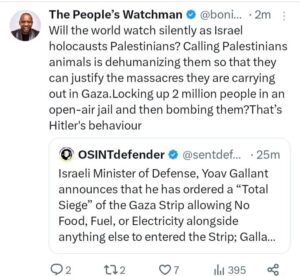
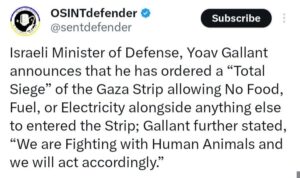
The situation further intensified when Israel’s Minister of Defense, Yoav Gallant, announced a total siege of the Gaza Strip.
This siege effectively cut off the region from essential supplies like food, fuel, and electricity.
Gallant’s statement added to the controversy as he referred to those in Gaza as “Human Animals” and vowed to act accordingly.

These developments have sparked international concern and debate.
Critics argue that such actions by the Israeli government are exacerbating an already dire humanitarian crisis in the Gaza Strip.
The conflict has resulted in significant civilian casualties and the displacement of thousands of Palestinians.
As the international community grapples with this crisis, there are calls for a peaceful resolution to the Israel-Palestine conflict.
Many nations and organizations have urged both sides to cease hostilities and engage in meaningful dialogue to find a lasting solution to the decades-long dispute.
The situation remains complex, with deeply rooted historical, political, and religious factors at play, making the pursuit of peace a challenging endeavor.
Boniface Mwangi’s remarks highlight growing concerns about the Israel-Palestine conflict, as the situation continues to escalate and raise questions about the impact on the civilian population and the prospects for a peaceful resolution.
The international community faces a pressing challenge in finding a path towards stability and reconciliation in the region.
