



Through a recent social media post, a seasoned businessman shared an intriguing encounter he had with six youths dressed in Kenya Revenue Authority (KRA) uniforms.
With three decades of business experience under his belt, this was a first for him.
He recounted countless encounters with various authorities throughout his career, from armed robbers to regulatory officers, but the KRA was uncharted territory.

The six KRA personnel entered his shop with a barrage of questions, leaving the businessman bewildered.
They probed into areas beyond the scope of tax collection, delving into the intricacies of his business operations.
Their inquiries ranged from other ventures he might be involved in to his annual turnover, rent expenses, and even the identity of his landlord. It was at this point that the businessman’s patience wore thin.
Frustration bubbling, he issued a stern warning to the inquisitive KRA officials.
He mentioned something cryptic: “Mambo ni Matatu, sorry ni Mawili…” This phrase, translated as “Two things are necessary,” hinted at the need for these officials to wield two essential elements.
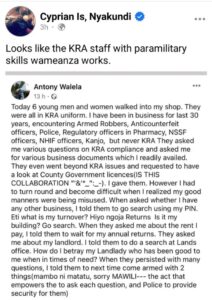
The first was the knowledge and authority granted by the law, empowering them to ask such probing questions. The second was the backing of law enforcement, ensuring their safety during their inquiries.
The businessman was steadfast in protecting his landlady, someone who had been a reliable figure throughout his years in business.
He challenged the KRA officials to investigate any matters concerning her at the Lands Office, emphasizing that he would not betray her trust.
A well-known blogger who shared this intriguing story shed some light on the possible identity of these enigmatic KRA personnel.
They were speculated to be part of the recently graduated Revenue Service Assistants, a new group established by the government to bolster tax compliance efforts.
Reports indicated that KRA had already deployed these Service Assistants, but it seemed that many Kenyans were still in the dark about their exact role and responsibilities.
These tax agents were tasked with a range of duties, including online registration of trading businesses, verifying taxpayer information, providing support for compliance with the Taxpayer Information Management System (TIMS), enforcing excise regulations, and collecting crucial data for the tax authorities.
As Kenya seeks to enhance its tax collection and compliance efforts, encounters like the one experienced by the businessman shed light on the evolving landscape of tax enforcement in the country.
The blend of traditional tax officers and these newly minted Revenue Service Assistants reflects the government’s commitment to ensuring businesses meet their tax obligations.
In a world where tax evasion and irregularities can have far-reaching consequences, the role of these KRA officials is becoming increasingly significant.
The businessman’s encounter with the KRA personnel in uniforms opened a window into the evolving tax compliance landscape in Kenya.
It showcased the presence of the newly established Revenue Service Assistants and their unique responsibilities in ensuring businesses adhere to tax regulations.
This encounter served as a reminder of the critical role tax authorities play in maintaining fiscal discipline and collecting revenue for the betterment of the nation.
